

TRAINING & LIFE AS A PUPIL
TRAINING & LIFE AS A PUPIL: RICHMOND CHAMBERS
Learning to practise as a specialist immigration barrister
Pupillage at Richmond Chambers is designed around a simple objective: by the end of the year, a successful pupil should be ready to begin practice as a confident and capable specialist immigration barrister.
That requires more than knowledge of immigration law.
A good immigration barrister needs to analyse difficult facts, identify the right legal route or remedy, advise clients clearly, exercise judgment, prepare evidence, draft persuasively, manage a case and advocate effectively.
Our pupils develop these skills through real client work, close supervision, structured feedback, advocacy training, monthly seminars and external professional development.
Responsibility increases progressively throughout the year.
First six: learning how cases are built
During their first six, our pupils work alongside experienced barristers on live matters across the breadth of our practice.
The emphasis is not simply on observing or completing artificial exercises. It is on understanding how each piece of work contributes to the strategy and progression of a genuine case.
Work may include:
- analysing instructions and Home Office decisions;
- identifying legal and evidential issues;
- legal and factual research;
- preparing for and attending client conferences;
- drafting written advice;
- preparing immigration applications and representations;
- witness statements and evidence preparation;
- administrative review;
- appeal preparation;
- grounds of appeal;
- skeleton arguments;
- judicial review merits;
- pre-action protocol correspondence; and
- hearing preparation.
Pupils learn how law, evidence, strategy and client objectives interact.
Learning through real clients
Direct client work is fundamental to our practice.
Pupils attend conferences from an early stage and see how experienced barristers identify what the client is trying to achieve, analyse the available routes and remedies and turn instructions into a legal strategy.
That strategy may involve an application, but it may equally involve an appeal, bail application, administrative review or public law challenge.
As their knowledge and confidence develop, pupils assume progressively greater responsibility under supervision.
They learn how to:
- give clear and realistic advice;
- explain complex law to non-lawyers;
- identify weaknesses or gaps in evidence;
- advise on prospects and risk;
- manage expectations;
- work sensitively with vulnerable clients;
- deal appropriately with urgent developments; and
- exercise judgment where there may be no perfect answer.
These are particularly important skills in direct-access practice, where the barrister is often responsible not only for legal analysis and advocacy but also for helping the client understand and navigate the case.
Second six: beginning to practise
During second six, pupils begin to undertake suitable work in their own right while continuing to receive supervision and support.
This includes advocacy.
Depending on the pupil’s experience and the work available, second-six advocacy may include:
- First-tier Tribunal immigration appeals;
- asylum and human rights appeals;
- immigration bail applications;
- case management hearings; and
- other appropriate tribunal work.
Advocacy can arise in different ways.
A pupil might appear in a direct-access appeal for a client whose case Richmond Chambers has advised on and prepared from an earlier stage.
On another occasion, the pupil may be instructed by a solicitor or IAA-regulated representative specifically to conduct a hearing.
Pupils can normally expect regular tribunal work during second six, with the complexity of their work increasing as their experience develops.
At the same time, they continue to advise clients, draft, work on applications and appeals and assist with more complex litigation.
We want junior barristers who can stand on their feet in court, but who also understand everything that should have happened before the hearing began.
Judicial review and public law
Immigration judicial review forms an important part of our practice.
Pupils may assist with cases involving unlawful decisions or delay, detention, removal, fresh claims, sponsor licensing, nationality, the EU Settlement Scheme and other public law issues.
Under supervision, this may involve:
- identifying potential public law errors;
- considering alternative remedies;
- analysing merits;
- drafting pre-action protocol correspondence;
- preparing grounds;
- analysing and preparing evidence;
- urgent case strategy;
- claim preparation; and
- preparation for permission and substantive hearings.
Pupils therefore develop an understanding not only of immigration law and the statutory appeal system but also of the wider public law framework within which immigration decision-making operates.
The sort of work you may encounter
The precise casework a pupil encounters will depend on the live matters we are handling, but may typically include:
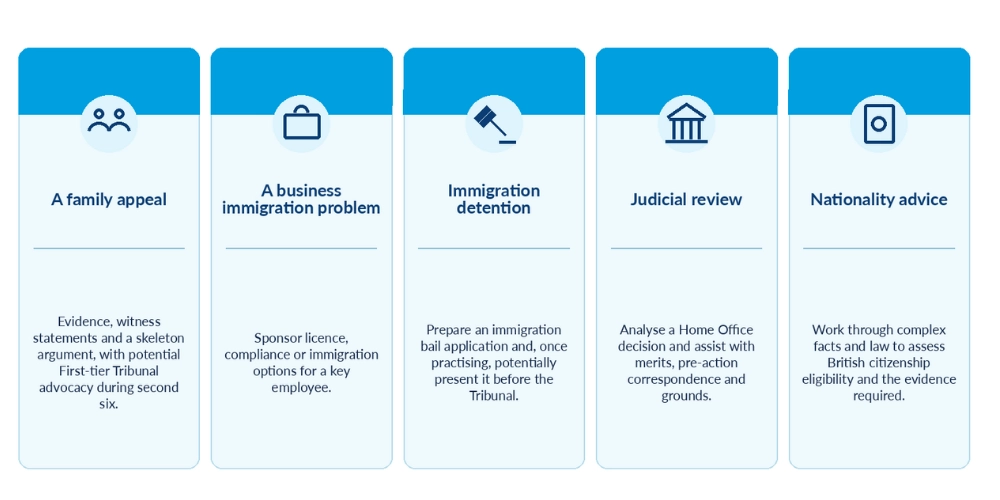
These examples illustrate an important feature of pupillage at Richmond Chambers: the work is rarely confined to one type of client, one procedure or one form of advocacy.
Two pupil supervisors – and a wider team to learn from
Each pupil has two formal supervisors.
One principally practises in personal immigration law and the other in business immigration.
This gives pupils structured exposure to different parts of immigration practice and avoids training through a single narrow lens.
Pupils also work for other barristers across Chambers.
They therefore encounter different approaches to:
- analysis;
- drafting;
- advocacy;
- evidence;
- client care;
- commercial judgment; and
- case strategy.
Because Richmond Chambers is relatively small, pupils also have regular access to colleagues beyond their formal supervisors.
The aim is not to produce pupils who imitate one practitioner. We aim to expose our pupils to good practice and help them develop their own professional judgment and style.
Training beyond the case
Real casework sits at the centre of pupillage, but it is supplemented by structured professional development.
Monthly Chambers seminars
Members of Chambers meet regularly to discuss legal and procedural developments, difficult cases and specialist areas of practice.
Pupils participate and are encouraged to contribute.
Advocacy training
Pupils undertake internal advocacy exercises and receive individual feedback from experienced barristers.
Training may include submissions exercises, mock hearings, witness handling and recorded advocacy.
External training
Where external training will contribute to a pupil’s development, Richmond Chambers funds appropriate courses and programmes.
Keeping up with immigration law
Immigration law changes rapidly.
Pupils learn how to keep abreast of legislation, Immigration Rules, Home Office guidance, tribunal procedure and developing case law – and how to translate those changes into practical advice.
Writing and professional profile
Pupils are encouraged to contribute to our Immigration Law Knowledge Centre and other professional materials.
The ability to explain difficult law clearly and accurately is valuable in written advice, advocacy and professional writing alike.
Pro bono experience
Pupils may contribute to our pro bono work, including through organisations such as Bail for Immigration Detainees and the Refugee and Migrant Forum of Essex and London.
During their second six, this may include suitable pro bono advocacy.
For pupils, the work combines useful professional experience with an opportunity to assist people who may otherwise struggle to obtain specialist representation.
What might a week involve?
Whilst there is no standard week, a typical week might be as follows:
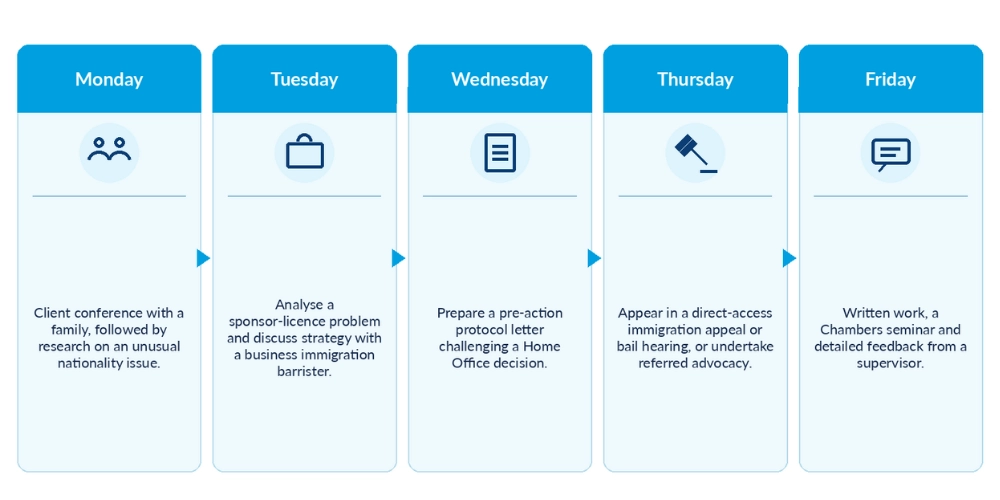
This combination of client work, applications, appeals, drafting, strategy, public law and advocacy is one of the central attractions of pupillage at Richmond Chambers.
What pupillage at Richmond Chambers is like
We expect pupils to work hard and maintain high professional standards.
We do not regard routinely excessive hours as evidence of commitment.
The normal working day is 9am to 6pm, Monday to Friday, although hearings, genuinely urgent cases and professional responsibilities can occasionally require flexibility.
From January 2027, our pupils will work from 3 King’s Bench Walk, Inner Temple.
Pupils may also work remotely for part of the week, subject to supervision, training, casework, hearings and client requirements.
Richmond Chambers is a relatively small specialist team. Pupils work closely with barristers, legal associates and professional support staff and are encouraged to discuss difficult issues rather than struggle with them in isolation.
Feedback and assessment
Feedback is regular, candid and developmental.
Pupils receive feedback on:
- legal analysis and research;
- written advice;
- drafting;
- advocacy;
- evidence and case preparation;
- client care;
- professional communication;
- judgment;
- reliability; and
- professionalism.
Progress is reviewed throughout the year.
If concerns arise, our approach is to identify them early, explain them clearly and give the pupil a fair opportunity to improve.
Richmond Chambers does not operate a competitive pupillage model.
Pupils are not ranked against one another and do not compete for a fixed number of positions.
Each is assessed individually against the standard required to begin practice successfully as a barrister at Richmond Chambers.
What our pupils say
Grace Storrie
Former pupil, now immigration barrister
“During my pupillage at Richmond Chambers, I had the opportunity to learn from practitioners with an extraordinary depth of knowledge and experience in immigration law. I particularly valued the collaborative and supportive atmosphere within Chambers. As I found my feet in the Immigration Tribunals during my second six, I was given the opportunity to develop my own advocacy practice and take real responsibility for cases, while members at every level were always willing to make time to talk through a difficult point, offer guidance or provide a second opinion.”
Alex Ferguson
Former pupil, now immigration barrister
“Pupillage at Richmond Chambers gave me the opportunity to work closely with highly experienced barristers across a broad range of immigration cases. I really enjoyed how my ideas were valued when working as part of a team, while also being given increasing responsibility for my own clients and cases as my pupillage progressed. That combination of high-quality work, responsibility, and accessible support was excellent preparation for developing my own practice as an immigration barrister at Richmond Chambers.”
Eve Loveman
Current pupil barrister
“I really value the collaborative working environment at Richmond Chambers. Since commencing my pupillage, I have been encouraged to put forward my own ideas and make a meaningful contribution to complex immigration work, including judicial reviews and appeals. I have been exposed to challenging and interesting cases from an early stage, while feeling supported to take on increasing responsibility and new challenges as my pupillage develops.”