

PUPILLAGE
PUPILLAGE: RICHMOND CHAMBERS
Specialist immigration pupillage with real responsibility from the start
Richmond Chambers offers a specialist pupillage for aspiring barristers who want to build a career at the Immigration Bar.
From the beginning of pupillage, you will work on real cases across the breadth of immigration, asylum and nationality law. You will have regular contact with clients, learn how applications, appeals and challenges are built, develop your advocacy and gain experience of both personal and business immigration.
Because much of our work is undertaken directly for individuals and businesses, our pupils see cases from an unusually early stage. They learn how to identify the problem, advise the client, develop the evidence and strategy, prepare the case and, where appropriate, advocate for the client before a court or tribunal.
This gives our pupils experience of the full lifecycle of a case and an understanding of how effective advocacy is shaped by the advice, preparation and strategic decisions that come before it.
You will be supported by two pupil supervisors, work closely with barristers across Chambers and benefit from structured advocacy training, monthly seminars and funded external professional development.
In January 2027, Richmond Chambers is moving to 3 King’s Bench Walk, in the heart of Inner Temple, where our pupils will be based and trained.
Pupillage at a glance
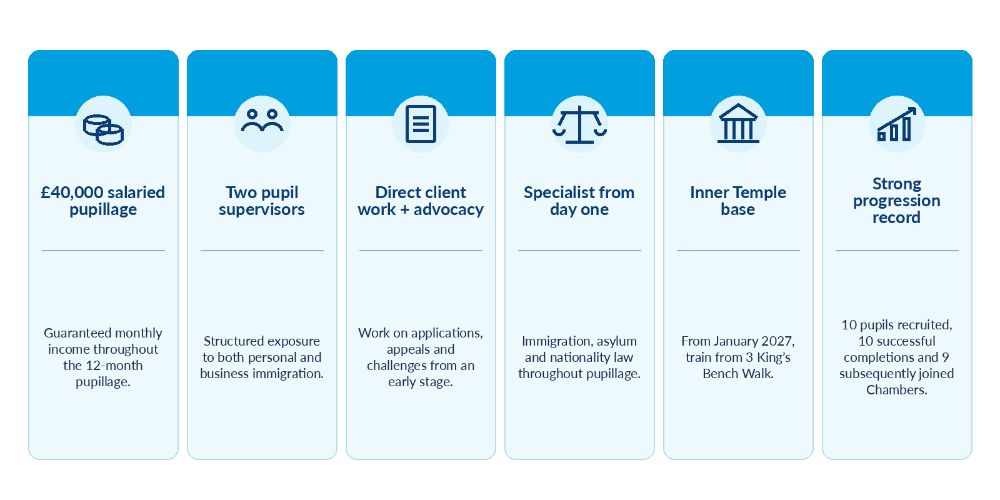
What makes pupillage at Richmond Chambers different?
Become an immigration specialist from day one
If you already know that you want to practise immigration law, Richmond Chambers offers the opportunity to specialise from the beginning of your career.
Immigration is not one practice area among many. It is what we do.
Our work spans the full range of immigration, asylum and nationality law, including:
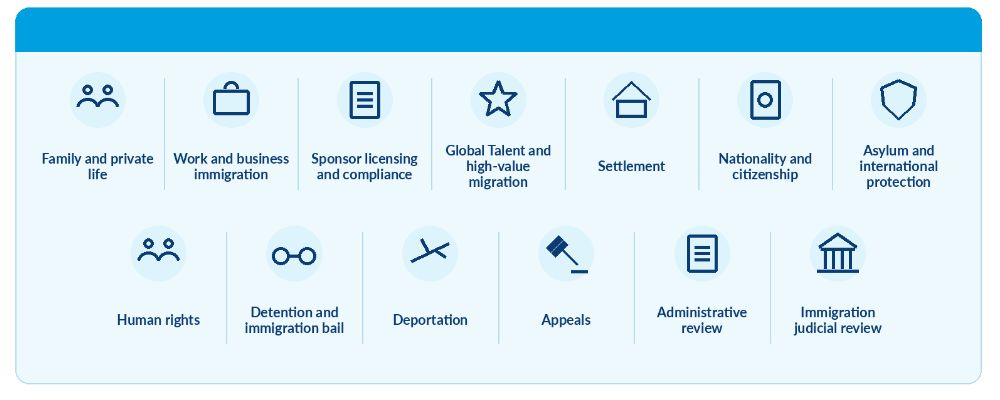
Our pupils therefore see considerably more than asylum and human rights appeals.
They work on applications as well as challenges, personal immigration as well as business immigration, advisory work as well as advocacy, and tribunal cases as well as public law challenges.
The legal issues can be difficult, the evidence complex and the consequences for clients significant. That variety is one of the defining features of practice at Richmond Chambers.
Work on the whole case
Direct access is central to the way we practise.
We are often instructed before a case has taken shape. Our barristers may meet their client at the outset, identify the appropriate route or remedy, advise on evidence and strategy, prepare an application or appeal and, if the matter becomes contentious, represent their client before the tribunal or higher court.
Pupils see that entire process.
They attend conferences, analyse evidence, undertake legal research and assist with advice, applications, representations, witness statements, grounds, skeleton arguments and hearing preparation.
During second six, our pupils begin to undertake appropriate work in their own right, including advocacy.
That advocacy comes from both sides of our practice.
We represent our own direct-access clients in appeals and other suitable proceedings. We also accept instructions from solicitors and IAA-regulated representatives for specialist drafting, advice and hearings.
Several of our junior barristers undertake substantial referred advocacy alongside their direct-access practices.
Our pupils therefore learn not only how to present a case, but how to build, shape and take responsibility for one.
Work that matters
Immigration law has an unusually direct impact on people’s lives.
A successful case may reunite a family, secure protection for somebody fleeing persecution, bring an individual out of detention, allow a business to recruit a key employee or enable somebody who has built their life in the UK to finally obtain permanent status or citizenship.
Because we frequently act directly for clients, our barristers often see that impact at close quarters. They may first meet a client at a moment of considerable uncertainty and remain involved until the outcome is known.
For many of our barristers, sharing that outcome with the client is one of the most rewarding aspects of practice.
We also support pro bono work, including through organisations such as Bail for Immigration Detainees and the Refugee and Migrant Forum of Essex and London.
Pupils may contribute to appropriate pro bono matters and undertake suitable pro bono advocacy during their second six.
How we train pupils
Each pupil has two formal supervisors: one principally focused on personal immigration and the other on business immigration.
Pupils also work with other barristers across Chambers, exposing them to different approaches to analysis, drafting, advocacy, evidence, client care and case strategy.
Alongside real casework, pupils benefit from:
- regular individual feedback;
- internal advocacy training;
- monthly Chambers seminars;
- legal and procedural updates;
- case discussions; and
- funded external training where appropriate.
Training is progressive. Responsibility increases as competence develops.
And support does not stop at the end of the 12-month pupillage.
Barristers who join Richmond Chambers after qualification receive enhanced senior-barrister support during their first six months of practice and continuing supervision throughout our New Practitioner Programme.
A close-knit specialist team
Richmond Chambers is a relatively small specialist Chambers.
Pupils work directly with experienced practitioners across Chambers and become part of a close-knit team in which colleagues regularly discuss difficult points of law, evidence, strategy and procedure.
That accessibility continues after qualification.
Our work involves individual professional responsibility, but it is not an isolated way of practising.
From January 2027, the Richmond Chambers immigration team will be based at 3 King’s Bench Walk in the Inner Temple, giving our barristers and pupils a professional home at the heart of the Bar.
After pupillage
We recruit pupils because we hope they will build their careers with us.
Our recent progression record:
- 10 pupils have been recruited.
- All 10 successfully completed pupillage.
- 9 subsequently joined Richmond Chambers as barristers.
Our former pupils have gone on to build specialist immigration practices, undertake complex cases, supervise future pupils and become partners.
Our qualified barristers practise within a distinctive model that combines substantial professional autonomy with the security and benefits of employment.
Where an employment offer is made, newly qualified barristers move into a six-month transition period with enhanced supervision from a senior barrister. During this period they practise as fully qualified immigration barristers and receive a salary of £45,000 together with the full benefits package available to our employed barristers.
Following successful completion of the transition period, the guaranteed base salary increases to £50,000 – within the first year of practice – together with the opportunity for additional percentage-based remuneration as the barrister’s practice develops.
The £50,000 base is a starting point, not a ceiling. As a barrister’s practice develops, earnings have scope to increase substantially, while retaining the security, benefits and professional infrastructure of an employed position.
Our barristers can shape their own practices and choose suitable work according to their interests, expertise and availability, while benefiting from 30 days’ paid annual leave plus bank holidays, flexible and remote working, maternity, paternity and parental leave, pension contributions, family private healthcare, funded professional costs and modern IT and case-management support.
Our barristers do not pay chambers’ rent or clerks’ fees.
For candidates deciding not just where to spend twelve months, but what kind of career at the Bar they want afterwards, that is an important part of the Richmond Chambers proposition.
Who should apply?
We are looking for candidates with the potential to become excellent immigration barristers.
In particular, we look for evidence of:
- intellectual and analytical ability;
- written communication;
- oral communication and advocacy potential;
- sound judgment;
- genuine motivation for immigration practice;
- commitment to a career at the Bar;
- professionalism and integrity;
- resilience;
- aptitude for direct client work; and
- ability to work collaboratively.
Previous immigration experience can be helpful, including as evidence of a candidate’s motivation for immigration practice, but it is not essential.
Neither a Richmond Chambers mini-pupillage nor previous employment as one of our legal associates is required, and neither confers automatic preference. Both may provide relevant evidence against our selection criteria, just as relevant experience gained elsewhere may do.
We welcome candidates from different backgrounds and career paths.
For general recruitment queries contact Kian Richardson, Senior Chambers Administrator, kian.richardson@richmondchambers.com.