

LIFE AFTER PUPILLAGE
LIFE AFTER PUPILLAGE: RICHMOND CHAMBERS
Build your career as a specialist immigration barrister
Pupillage at Richmond Chambers is offered with a view to a long-term career.
For many barristers, one of the attractions of the Bar is professional autonomy: the opportunity to develop expertise, shape a practice and take responsibility for the direction of a career.
Richmond Chambers combines that autonomy with the security and benefits of employment.
Our barristers have complete control over the work they undertake and the practices they build, while receiving a guaranteed income, paid holiday, flexible working, professional support and a package of financial, professional, lifestyle and wellbeing benefits.
Our model is designed to combine much of what attracts barristers to independent practice at the Bar, with the security of employed practice.
Build the practice that interests you
There is no traditional clerking model at Richmond Chambers.
New enquiries and instructions are made available internally and barristers decide which suitable matters they wish to undertake, having regard to their expertise, interests, availability, capacity and professional obligations.
As Richmond Chambers is regulated as a law firm by the Solicitors Regulation Authority, our employed barristers are not subject to the cab-rank rule. This gives them considerable freedom to choose the clients and cases they wish to take on, subject of course to their professional and regulatory obligations.
This allows different barristers to build very different practices.
One may become particularly interested in business immigration and sponsor licensing. Another may develop a practice combining asylum, appeals and judicial review. Another may concentrate on family migration, nationality or complex private-client work.
Barristers can also develop the balance they prefer between:
- direct-access cases;
- advisory work;
- immigration applications;
- appeals;
- public law;
- specialist drafting; and
- referred advocacy.
The result is genuine scope to shape a practice around the work each individual finds most intellectually and professionally rewarding.
A broad immigration practice
Our barristers advise and represent individuals, families, entrepreneurs, international businesses, UK employers, sponsors, students, people seeking protection and individuals facing detention or removal.
Their work may involve:
- family migration;
- work and business immigration;
- sponsor licensing and compliance;
- Global Talent;
- settlement;
- nationality and citizenship;
- asylum and human rights;
- detention and bail;
- appeals;
- administrative review;
- judicial review; and
- wider public law issues.
A single week might therefore combine advice to a business, a family immigration case, preparation of a direct-access appeal, drafting grounds on instructions from a solicitor, a bail hearing and work on a judicial review.
Junior barristers are not confined to one narrow category of immigration work.
Direct access and referred advocacy
Much of our work comes directly from individuals and businesses.
This means our barristers can become involved from the outset, help shape the strategy, evidence and presentation of a case and then share in the outcome.
Direct access also generates advocacy.
We represent direct-access clients in immigration appeals and other appropriate proceedings, so the barrister who has helped prepare the matter may ultimately present it before the Tribunal.
We also accept instructions from solicitors and IAA-regulated representatives for specialist advice, drafting and hearings.
Several of our junior barristers undertake substantial referred advocacy alongside their direct-access practices.
This allows barristers to build the combination of advisory, client, drafting and advocacy work that best suits them.
Your first year in practice
Where an employment offer is made, newly qualified barristers begin practice on a salary of £45,000, together with the full benefits package available to our employed barristers.
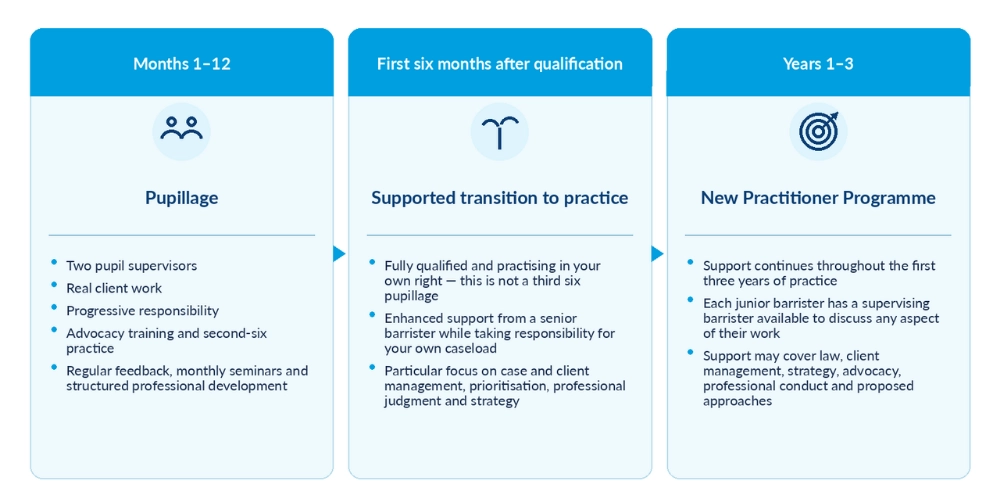
The first six months of practice form a structured transition period. Although fully qualified and practising as immigration barristers in their own right, new practitioners receive enhanced supervision from a senior barrister as they assume responsibility for their own clients and cases.
Following successful completion of this six-month transition period, the guaranteed base salary increases to £50,000 – within the first year of practice.
The £50,000 base is a starting point rather than a ceiling on earnings. Base salaries are reviewed annually as a barrister’s practice develops, and additional percentage-based remuneration is available where fee receipts exceed the level reflected in the base salary. This provides scope for earnings to increase substantially over time, while retaining the financial security, employment benefits and professional infrastructure of an employed position.
Our barristers also benefit from:
- 30 days’ paid annual leave plus bank holidays
- Additional unpaid leave with no fixed annual cap, subject to appropriate arrangements for professional commitments
- Pension contributions
- All reasonable professional travel expenses paid, including travel from Chambers to courts, tribunals, client meetings and other professional appointments throughout the UK
- Private medical insurance for the barrister and their family
- Maternity, paternity and parental leave, including generous maternity benefits with six months on full pay
- Flexible working hours
- Freedom to work remotely or from Chambers, subject to hearings, conferences, client requirements and professional obligations
- Funded professional memberships, subscriptions and training
- Ability to carry forward or sell back up to five days of annual leave
- Employee wellbeing and discounts app
- Interest-free season-ticket or travel-card loans and discounted gym membership where available
Professional costs funded by Chambers
Salary sits alongside employment benefits and funded professional infrastructure. Richmond Chambers meets a range of professional costs that a barrister in self-employed practice would ordinarily fund personally.
Our barristers do not personally pay:
- chambers rent;
- clerks’ fees;
- professional indemnity premiums;
- personal accountancy fees associated with self-employment;
- practising certificate costs;
- Bar Council membership;
- ILPA membership;
- Electronic Immigration Network subscriptions;
- Free Movement subscriptions;
- approved professional training costs; or
- reasonable travel expenses incurred in connection with practice.
Barristers also benefit from legal associate and administrative support, modern IT equipment, secure cloud systems, videoconferencing and digital case-management tools.
Work flexibly
Qualified barristers have considerable freedom to organise where and when they work.
Subject to hearings, conferences, client needs and professional responsibilities, they may work remotely or from Chambers according to preference.
Working hours are also flexible.
Our focus is on professional standards, client service and delivery rather than requiring barristers to be at a particular desk for prescribed hours. We aim to organise work so that barristers are not routinely dealing with last-minute briefs or working evenings and weekends, while recognising that hearings and genuinely urgent matters can sometimes require flexibility.
From January 2027, barristers who choose to work from Chambers will do so from 3 King’s Bench Walk in the Inner Temple. Subject to employment, regulatory, confidentiality and client-service requirements, working from further afield may also be possible.
Responsibility comes early – support continues
Direct-access practice brings unusually broad professional responsibility.
A barrister may need not only to identify the correct law and advocate effectively, but also to manage the case, manage the client, identify the next step, control deadlines, communicate difficult advice and make sound strategic decisions without an instructing solicitor acting as an intermediary.
We therefore do not treat the end of pupillage as the point at which support suddenly disappears. Instead, newly qualified barristers move through a structured transition into increasingly independent practice, with enhanced senior-barrister support during their first six months after qualification and continuing support throughout our New Practitioner Programme.
From pupil to independent practitioner
Independent, but not isolated
Richmond Chambers is a relatively small specialist practice.
Barristers have their own clients and professional responsibilities, but they work within a collegiate team in which colleagues regularly discuss difficult cases, strategy and developments in the law.
Monthly Chambers seminars provide a formal opportunity to share expertise, but much of the collegiate culture is informal: asking another barrister for a view, discussing an unfamiliar issue or drawing on somebody else’s experience.
That accessibility is particularly valuable to junior practitioners.
The objective is genuine professional independence, not professional isolation.
Training after qualification
Professional development continues alongside supervision.
Junior barristers benefit from:
- monthly Chambers seminars;
- funded external training;
- training through our New Practitioner Programme;
- advocacy feedback;
- support when developing unfamiliar areas of practice;
- CPD planning; and
- guidance on building and developing their practices.
As experience grows, barristers increasingly determine the direction of their own development.
See the outcome of your work
One of the attractions of direct-access practice is the relationship between the work and its outcome.
A barrister may meet a client before a case has taken shape and remain involved throughout months of uncertainty.
They may ultimately be the person who tells a family that an application or appeal has succeeded, a refugee that they have obtained protection, an employer that its sponsor licence has been approved or a long-term resident that they have finally become British.
The legal questions may be technically difficult, but the reason for solving them is rarely abstract.
There is usually a person, family or business whose future depends on the answer.
From pupil to established practitioner
We recruit pupils with a view to long-term careers.
Our recent progression record:
- 10 pupils recruited
- 10 successfully completed pupillage
- 9 subsequently joined Richmond Chambers as barristers
Former pupils have gone on to develop specialist practices, undertake complex cases, supervise future pupils and become partners.
For applicants choosing between pupillage opportunities, the question is therefore not simply:
Where do I want to spend twelve months?
It is also:
What kind of barrister do I want to become, and what kind of professional life do I want to build?
At Richmond Chambers, we offer specialist and varied work, early responsibility and substantial professional autonomy – within a collegiate practice that provides financial security, flexibility and structured support from pupillage through the early years of practice and beyond.