



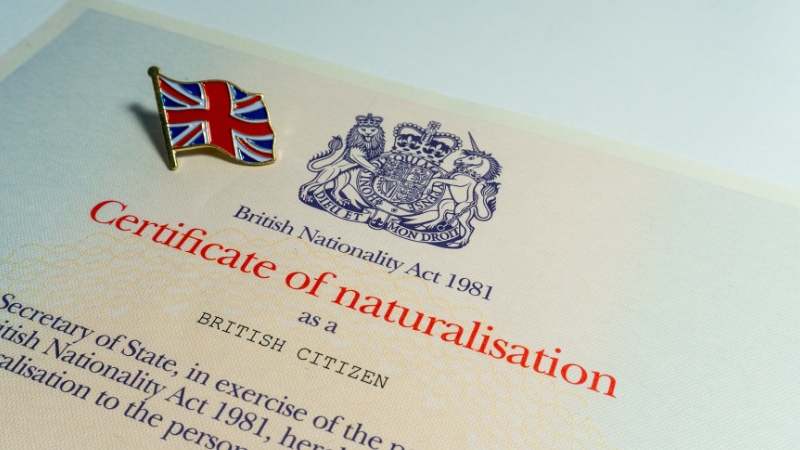
Naturalisation as a British Citizen When Married to a British Citizen

In This Article:
A person aged 18 or over who is married to, or in a civil partnership with, a British citizen may apply to naturalise under section 6(2) of the British Nationality Act 1981. Unlike the usual five-year route, the qualifying residence period is three years and there is no requirement to wait 12 months after obtaining Indefinite Leave to Remain, Indefinite Leave to Enter or Settled Status under the EU Settlement Scheme.
Naturalisation is discretionary. An applicant must still satisfy the residence, immigration status, good character, language and Life in the UK requirements, unless a relevant statutory discretion, waiver or exemption applies.
1. Requirements for Naturalisation When Married to a British Citizen
In broad terms, an applicant should be able to show that:
- they are aged 18 or over;
- they are married to, or in a civil partnership with, a British citizen on the date of application;
- they are free from immigration time restrictions on the date of application;
- they have completed the relevant three-year residence period;
- they were physically present in the UK at the start of that three-year period;
- their absences are within the normal limits, or there is a proper basis for discretion;
- they meet the full-capacity and good character requirements; and
- they meet the English, Welsh or Scottish Gaelic language requirement and the Life in the UK requirement, unless exempt.
Marriage or Civil Partnership to a British Citizen
The applicant must be formally married to, or in a civil partnership with, a British citizen on the application date. The relationship itself does not have to have lasted for three years: the three-year rule relates to residence in the UK. Evidence will normally include the marriage or civil-partnership certificate and evidence that the spouse or civil partner is a British citizen.
A person whose British spouse or civil partner has died before the application date cannot rely on section 6(2), although another route to naturalisation may be available.
The Three-Year Residence Requirement
The residence period is three years ending with the application date. The applicant should normally have been living in the UK throughout that period, subject to the permitted absences and the other residence requirements below.
Physical Presence Exactly Three Years Before Applying
The applicant must normally have been physically present in the UK at the beginning of the three-year qualifying period.
The Home Office has limited discretion where the applicant was not present on the exact date because of special circumstances. In an appropriate case, an alternative application date may be considered with the applicant’s agreement. Discretion should not be assumed, and applicants should check the start date before submitting.
Absences From the UK
An applicant should normally have spent no more than 270 days outside the UK during the three-year period and no more than 90 days outside the UK during the final 12 months. Only whole days outside the UK count; the days of departure and return are not normally counted as days absent.
The Home Office may exercise discretion where absences exceed the normal limits. Small excesses are treated more favourably in the published guidance, while larger excesses require strong connections with the UK and additional reasons for the absences. The final-year limit is considered separately. A grant is not automatic simply because a case falls within a guidance range, and applicants with substantial absences should consider the detailed guidance on absences from the UK before applying.
Freedom From Immigration Time Restrictions
The applicant must be free from immigration time restrictions on the application date. This is commonly demonstrated by Indefinite Leave to Remain, Indefinite Leave to Enter, Settled Status under the EU Settlement Scheme, a right of abode or Irish citizenship. A spouse or civil partner of a British citizen does not normally need to hold that status for 12 months before applying.
Pre-settled status is limited leave and does not, by itself, amount to settled status. Some applicants may have acquired a permanent right protected by the Withdrawal Agreement, but this is a specialist and evidence-sensitive issue. You may wish to seek legal advice on this prior to making an application.
Lawful Residence and Immigration History
An applicant should not normally have been in breach of immigration laws during the three-year qualifying period. Where the applicant holds Indefinite Leave to Remain or Indefinite Leave to Enter, the Home Office guidance generally allows the lawful-residence requirement to be treated as met unless there is information to the contrary.
That does not mean that earlier immigration problems are irrelevant. Illegal entry, deception, illegal working and other immigration conduct may still affect the separate good character requirement.
Full Capacity
An adult applicant is normally required to have full capacity: broadly, they should understand that they are applying to become a British citizen. The requirement should not be applied in a discriminatory way because of disability or communication needs. It may be waived where that is in the applicant’s best interests, supported by appropriate evidence.
Good Character
Adult applicants must satisfy the good character requirement. There is no exhaustive statutory definition. The Home Office considers the applicant’s circumstances individually, including criminality, deception or dishonesty, immigration conduct, financial affairs, notoriety, terrorism, international crimes and other conduct said to be non-conducive to the public good. Positive factors can also be relevant, but they do not automatically outweigh serious adverse matters.
The current good character guidance states that applications made on or after 10 February 2025 involving illegal entry will normally be refused, subject to the terms of the guidance, any relevant exceptions and the individual facts. All material matters should be disclosed accurately. An applicant with a potentially adverse immigration or character history should review the current good character requirement carefully before applying.
English, Welsh or Scottish Gaelic Language Requirement
The language requirement can normally be met in one of the following ways:
- holding an accepted nationality from a majority English-speaking country;
- passing an approved Secure English Language Test at level B1 or above;
- holding a UK degree taught or researched in English; or
- holding an overseas degree supported by the required Ecctis assessment confirming the relevant UK equivalence and English-language position.
A B1-level qualification previously accepted for settlement can often be reused for naturalisation. Applicants aged 65 or over, or applicants with a qualifying long-term physical or mental condition, may be exempt. The evidence requirements should be checked against the current Form AN guidance.
Life in the UK Test
Most applicants must have passed the Life in the UK Test. The test currently consists of 24 questions, lasts 45 minutes and requires a score of at least 75%. The fee is £50 as at 4 August 2026. A previous pass can be reused; the test does not need to be taken again for naturalisation.
Applicants aged 65 or over, and applicants with a qualifying long-term physical or mental condition, may be exempt. The test should be booked only through the official Life in the UK booking service.
2. Applying, Fees and Decision Times
As at 4 August 2026, the naturalisation application fee is £1,709 and the citizenship ceremony fee is £130, making a total of £1,839. The standard service usually aims to decide an application within six months, although complex cases can take longer.
Eligible online naturalisation applicants may also be able to purchase the citizenship priority service for an additional £500. The service normally aims to provide a decision within 30 working days after biometric information is submitted, but it is not available for paper applications, cannot be added after submission and does not guarantee a decision within that period where further checks are required.
3. Contact Our British Citizenship Barristers
For expert advice and assistance with a British Citizenship by Naturalisation application when married to, or in a civil partnership with, a British citizen, contact our British citizenship barristers on 0203 617 9173 or complete our enquiry form.
4. Frequently Asked Questions: Naturalisation as a British Citizen When Married to a British Citizen
Can I apply immediately after receiving ILR or settled status?
Yes. A person applying under section 6(2) as the spouse or civil partner of a British citizen does not normally need to wait 12 months after obtaining ILR, ILE or settled status. All other requirements must still be met.
Do I need to have been married for three years?
No. The marriage or civil partnership must exist on the application date, but the three-year requirement relates to residence in the UK, not the length of the relationship.
Must I have been in the UK exactly three years before applying?
Normally, yes. Physical presence at the start of the three-year qualifying period is an exact-date requirement. Limited discretion may be available in special circumstances, but it should not be assumed.
What happens if my absences exceed 270 days or 90 days?
The Home Office may exercise discretion, but the outcome depends on the extent and timing of the absences, the applicant’s UK connections and the reasons for travel. Higher absences require a stronger case.
Does pre-settled status qualify for naturalisation?
Pre-settled status alone is limited leave and does not automatically satisfy the settled-status requirement.
Can I reuse my Life in the UK pass or English-language evidence?
A previous Life in the UK pass can be reused. A B1-level language qualification previously accepted for settlement can often be reused, but the current Form AN evidence rules should be checked.
Do I need to intend to make the UK my principal home?
The usual future-intentions requirement does not apply in the same way to a section 6(2) spouse or civil-partner application. Naturalisation remains discretionary and the other statutory requirements continue to apply.
How long does the application take and is priority service available?
The standard service usually aims to decide an application within six months. As at 4 August 2026, eligible online applicants may purchase a £500 priority service with a normal 30-working-day aim after biometrics, although complex cases can take longer.
Please note that the information provided in this article is for general guidance only and is based on the immigration rules and policies in force at the date of publication. Immigration law and Home Office policy can change frequently, and requirements may vary depending on individual circumstances. Legal advice should always be sought in relation to your specific situation.