



UK eGates for Children: Access to Expand from July 2026

In This Article:
This article considers UK eGate access for children, current eGate eligibility, when travellers must see a Border Force officer and the UK’s wider move towards contactless borders.
1. What Are UK eGates?
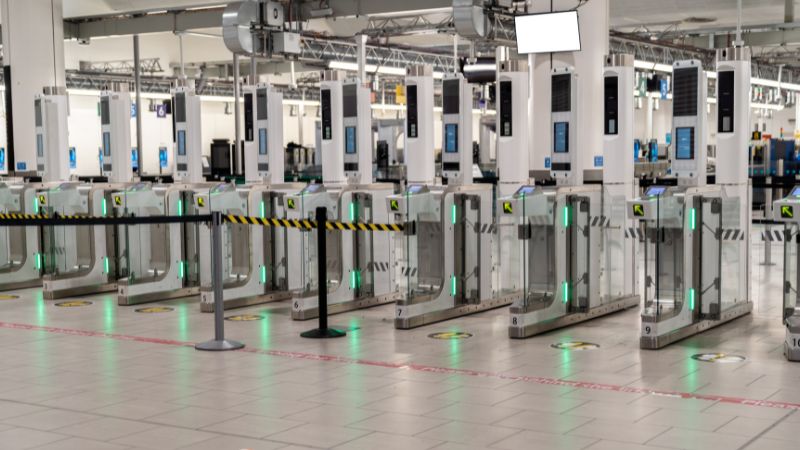
The eGates are self-service gates that allow eligible biometric passport holders to clear the border more efficiently, helping to avoid delays while maintaining security.
The eGates system has expanded over the years. In 1998, the first digital UK passport was introduced; this included a digital image of the photograph and signature. The first biometric passports, with an electronic chip featuring the holder’s data, were introduced in 2006. The first ePassport gates were introduced in the UK in 2008.
In December 2013, the then Immigration Minister, Mark Harper, officially opened the new generation of ePassport gates at Gatwick Airport.
In October 2018, the Government announced plans, as part of the Budget on 29 October 2018, to expand ePassport gate eligibility to millions more travellers arriving in the UK. There were then 259 ePassport gates in operation.
2. UK eGates: Who Can Use Them and When Must Travellers See a Border Force Officer?
There are now over 270 eGates in place at 15 air and rail ports in the UK. The eGates are designed to enable quicker travel into the UK. The system is monitored by border security officers. At present:
“You can normally use eGates if you:
- have a biometric symbol on the cover of your passport
- are aged 10+ (10 to 17 year olds must be accompanied by an adult)
- are either:
- a British citizen
- a national of an EU country, Australia, Canada, Iceland, Japan, Liechtenstein,New Zealand, Norway, Singapore, South Korea, Switzerland or the USA
- a member of the Registered Traveller Service”
You can read the full UK government guide on eGates here.
You cannot use the eGates if you are travelling with an ID card.
It is possible to fast-track passport control by paying a small fee at the following UK airports:
- Gatwick
- Heathrow
- Stansted
- Manchester
- Birmingham
- Glasgow
The FastTrack services vary depending on the airport and do not guarantee faster entry through Border Force.
Passengers no longer have to complete landing cards when arriving in the UK.
You must see a Border Force officer and obtain a passport stamp if you are seeking entry under the Temporary Creative Worker Visa route for a short-term assignment of up to 3 months.
In the event that you use the eGates by mistake, you must see a Border Force officer before you leave the port to receive a stamp in your passport.
If using the eGates, and in the absence of stamps in a passport, it is important to consider whether you should retain evidence of travel. This may be important and needed for a later UK immigration or nationality application.
3. UK eGate Eligibility, Border Force Referrals and Access for Children
Use of an eGate does not remove the requirement to meet the UK’s entry requirements. Travellers entering the UK as visitors should ensure that they meet the relevant UK Standard Visitor visa requirements. If you are not sure or have concerns, you may wish to consider seeking legal advice in advance of travel. Border Force may still refer a passenger to an officer, including where identity, security, safeguarding or immigration status checks are required.
If you are travelling with a child under 18 and you are not the child’s parent, or may appear not to be the parent, for example if you have a different family name, the Guide to faster travel through the UK border, updated April 2026, advises as follows:
“We do not wish to delay your journey any longer than necessary and it may help if you carry evidence of your relationship with the child and/or the reason why you are travelling with the child, this could include copies of:
- a birth or adoption certificate showing your relationship with the child
- a divorce or marriage certificates if you are the parent but have a different surname to the child
- a letter from the child’s parent(s) giving authority for the child to travel with you and providing contact details if you are not the parent”.
The Problems with ePassport gates (eGates) guidance dated April 2026 identifies further circumstances where border officers may need to confirm your identity or assess your eligibility to enter the UK.
You will be unable to use the eGates if there is a passport or microchip error; if there is a user error, for example if a passport is not removed from its protective case; or if you do not have a valid ETA, an eVisa or a digital exemption linked to the relevant UKVI account, or if your digital status is no longer valid.
The guidance reads:
“In the interest of national security, Border Force may not always be able to explain in detail why you have been unable to proceed through an eGate.”
4. Children Aged 8 and 9: UK eGate Access from July 2026
In a recent government announcement on 14 May 2026, the Home Office confirmed that up to 1.5 million more children will soon be able to use UK eGates, just in time for the summer. This figure is based on 2025 arrival rates:
“Children aged 8 and 9 years, who are at least 120cm (3ft 11in) tall and accompanied by an adult will become eligible under plans announced today
(….)
The expanded access is set to begin from Wednesday 8 July 2026, covering more than 290 eGates in UK and juxtaposed ports (where border checks take place in Europe).”
The announcement quotes the Minister for Migration and Citizenship, Mike Tapp:
“Travel with young children can be stressful for parents.
By expanding eGate access, more families can experience a swifter and smoother journey home – freeing up precious time this summer holiday season.
We are delivering continued improvement to the passenger experience, while keeping our borders safe and secure.”
5. Contactless Borders and the UK Electronic Travel Authorisation (ETA)
The Government confirmed that this is a further move towards “UK border transformation, delivering smooth journeys for passengers and protecting border security”.
The announcement continues:
“Contactless border will see state‑of‑the‑art facial comparison technology verify identity, rather than needing to present a passport. This is all whilst keeping our country’s borders secure.
The Home Office have enforced the Electronic Travel Authorisation (ETA) scheme since February of this year, with almost 25 million (24.8 million) ETAs having been issued since their introduction.”
The UK Electronic Travel Authorisation (ETA) is a digital permission to travel introduced as part of the UK’s move towards a more automated, “digital by default” border. It applies to certain non-visa nationals. The ETA enables the Home Office to carry out security and suitability screening before travel.
An ETA is not a visa and does not, by itself, grant immigration permission. Instead, it allows an eligible traveller to travel to the UK and present themselves at the border to be considered for entry in the usual way. This may include entry via the eGates. Border Force may still refuse entry if the person does not meet the relevant requirements on arrival.
For more information, including key features and requirements, read the UK Electronic Travel Authorisation (ETA) Application Guide.
6. Contact Our Immigration Barristers
For expert advice and assistance on ETAs, eVisas or any related visa or immigration application, contact our immigration barristers on 0203 617 9173 or complete our enquiry form.
7. Frequently Asked Questions: UK eGates for Children
What are UK eGates?
UK eGates are self-service gates that allow eligible biometric passport holders to clear the UK border more efficiently while maintaining border security.
Who can normally use UK eGates?
Eligible users normally include British citizens, and certain other nationalities, and members of the Registered Traveller Service, provided they have a biometric passport and meet the age requirements.
Can children use UK eGates?
At present, children aged 10 and over may normally use eGates if they meet the requirements, with 10 to 17 year olds accompanied by an adult. From 8 July 2026, access is expected to expand to eligible children aged 8 and 9 who are at least 120cm tall and accompanied by an adult.
When must a traveller see a Border Force officer instead of using an eGate?
A traveller must see a Border Force officer where a passport stamp is required, including where they are seeking entry under the Temporary Work – Creative Worker route for a short-term assignment of up to 3 months.
Does using an eGate remove the need to meet UK entry requirements?
No. Use of an eGate does not remove the requirement to meet the UK’s entry requirements, and Border Force may still refer a passenger to an officer.
What evidence may help when travelling with a child through the UK border?
Evidence may include a birth or adoption certificate, a divorce or marriage certificate where surnames differ, or a letter from the child’s parent giving authority for the child to travel.
What is a UK Electronic Travel Authorisation?
A UK Electronic Travel Authorisation is a digital permission to travel, It is not a visa and does not itself grant immigration permission.
Please note that the information provided in this article is for general guidance only and is based on the immigration rules and policies in force at the date of publication. Immigration law and Home Office policy can change frequently, and requirements may vary depending on individual circumstances. Legal advice should always be sought in relation to your specific situation.